By
Bamanga Abdullahi
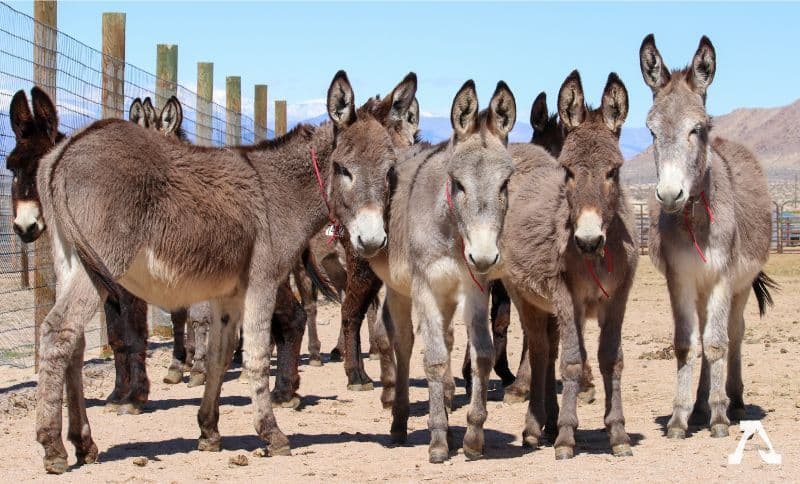
The slaughter and trade of donkeys is not peculiar to Adamawa State, as the practice has existed for years in several parts of northern Nigeria.
However, growing international demand for donkey skins has increased attention on the business and concerns over its regulation.
A Radio Nigeria investigation examined the operations of donkey abattoirs in Muchalla, Gombi Local Government Area of Adamawa State, where operators claim they conduct the business with the approval of relevant authorities and supply the meat to different parts of the country.
The Village Head of Muchalla, Usman Tadius, who also owns one of the abattoirs, said the business has existed in the community for more than ten years, adding that operations resumed after a four-year suspension.
He said business peaks during the dry season, when more than 100 donkeys are slaughtered weekly, processed and transported to markets in eastern and western Nigeria.
Another operator, Mr. Okechukwu, said he has been involved in the slaughter, processing and transportation of donkey meat for more than 16 years across Sokoto, Nasarawa, Kaduna, Gombe and Adamawa states.
He claimed the business operates with official approval and that most of the donkeys are sourced from Cameroon, Chad and the Central African Republic.
Responding to the operators’ claims, the Zonal Coordinator of the Ministry of Environment in Gombi, Mr. James T. Kamo, said the operators told him that officials of the Ministry of Environment, the Board of Internal Revenue and the Ministry of Commerce and Industry were aware of their activities and regularly visited the site to collect revenue.
The Adamawa State Coordinator of NAFDAC, Pharmacist Gonzor Bidima Nyor, said the agency regulates only packaged and processed food, drugs and other regulated products, adding that donkey slaughter falls under the Adamawa State Ministry of Livestock.
However, the Director of Veterinary Services and Epidemiology in the Ministry, Dr. Nyalas Bartholomew, said the slaughter of donkeys and the export trade in their skins are prohibited under a resolution adopted by African Heads of State at the African Union Summit in Addis Ababa in February 2024.
He said the resolution applies to all African Union member states, including Nigeria, and urged relevant authorities to enforce it.
According to him, the act is now classified as contraband in the country, and offenders are liable to prosecution.
On the religious perspective, Imam Tijjani Thahir of Modibbo Adama Mosque, Yola, said Islam prohibits the slaughter and consumption of donkey meat and advised Muslims to avoid the practice.
Citing the Holy Qur’an, he stated that Allah created horses, donkeys, and mules for transportation and adornment, and referenced authentic Hadith narrated by Imam Bukhari, and Islamic jurisprudence in Mukhtasar Khalil, Vol. 1, p. 218, which clearly forbid eating donkey meat.
Also speaking, Bishop Fali Indagawa of Kingdom Driven Church International, Numan, said Christianity does not expressly prohibit the slaughter or consumption of donkey meat, describing it as a matter of personal conviction rather than doctrine.
According to him, Romans 14:14 teaches that nothing is unclean in itself, while Matthew 21:2-14 shows donkeys used for transport with no scriptural prohibition on eating their meat.
Responding to the investigation, the Second-in-Command of the Police Public Relations Department, Adamawa State Police Command, ASP Usman Abdullahi Isa said the police neither issue licences nor approve abattoirs, as such responsibilities rest with the relevant government authorities.
He added that the command has not received any formal complaint or report of criminal activity relating to donkey abattoirs in Gombi.
The trade has expanded in recent years due to growing international demand for donkey skins, particularly for the production of ejiao a chinise traditional medicine.